Extend your DoE by scale
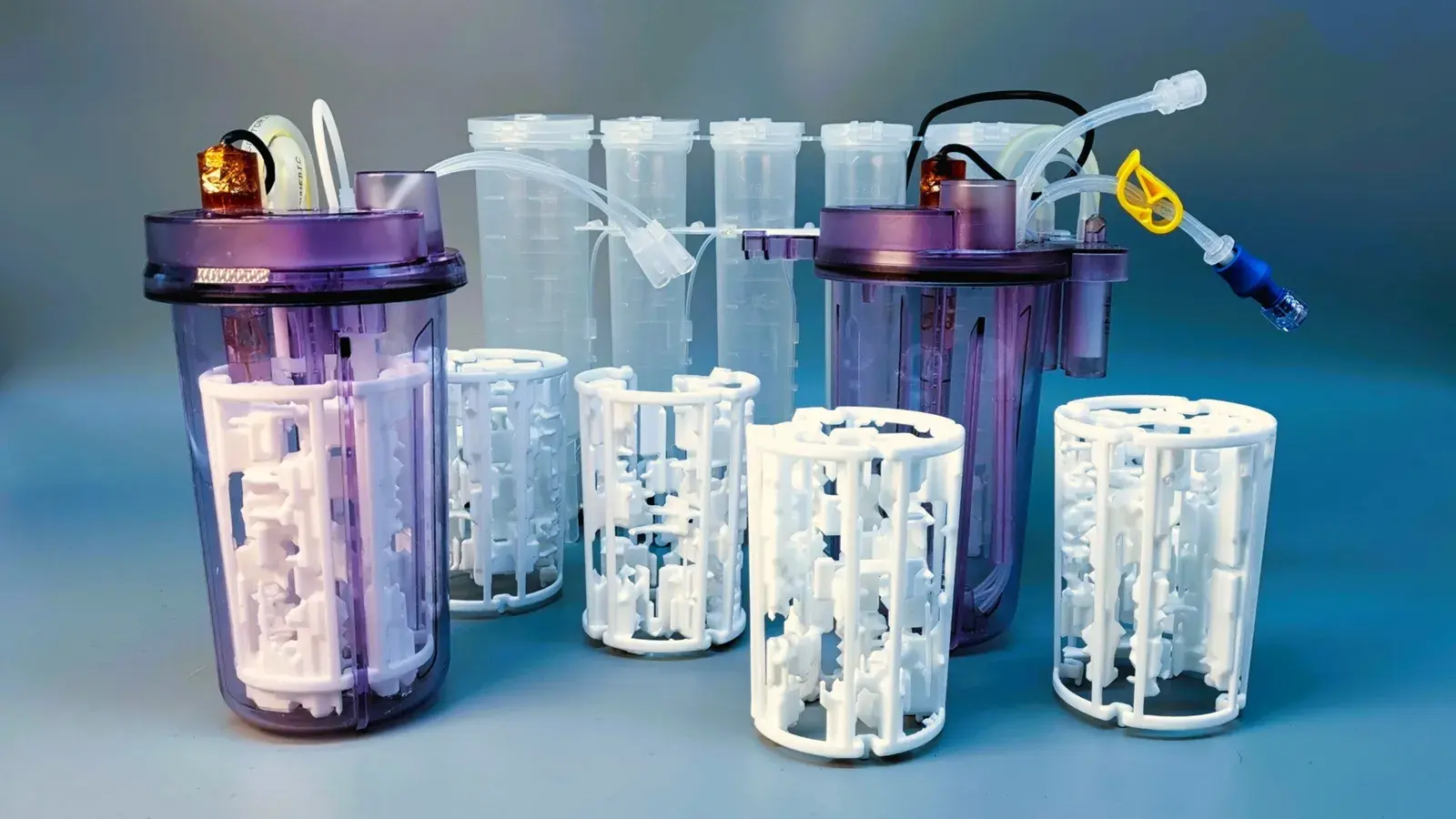
Three 3D-printed inserts - short, medium and long mixing time - turn four Ambr® 250 vessels into four scale conditions. Find out how your process reacts to scale before it ever leaves the lab.
One introductory set per customer at a launch price. Order by 31 December 2026 - delivery within 8 weeks. Price on request.
Request your set →One set, four scale conditions
Run your standard vessel as the lab reference and one vessel with each insert. Same stirrer, same probes, same control strategy - only the mixing time changes.
Lab reference
Fast mixing, homogeneous conditions - your current baseline. ≈ 5 s
Short mixing time
The first step towards large-scale mixing - the same with or without gassing. ≈ 29 s
Medium mixing time
Within the range published for 2,000 L single-use tanks. ≈ 42 s
Long mixing time
The slow end of large-scale mixing. ≈ 76 s
- See which parameters are sensitive to scale
- Find operating windows that hold at production scale
- Fix issues while they are still cheap to fix
Included
- 1 × insert S, 1 × insert M, 1 × insert L
- Nylon, single use - made by our ISO 13485-certified manufacturing partner, certificate included
- Data sheet with the mixing times of all three inserts - CFD and pH-indicator measurement
- Step-by-step guide for autoclaving and fitting
Fits your Ambr® 250
- Ambr® 250 modular and Ambr® 250 HT vessels
- You keep your standard vessel - the insert simply goes inside; ports, probes and sparger stay as they are
- Mixing times measured at 350 rpm with 200 mL, with and without gassing
- Fitted under the laminar flow hood in about five minutes, no tools - watch the video →
From lab mixing to large-scale mixing
Measured in the Ambr® 250 with a pH indicator: time until 95 % of the liquid has reached its final colour, at 350 rpm with 200 mL and 0.15 vvm, acid added through the feed line. For comparison: mixing times published for large single-use tanks.
Ambr® 250 gassed with 0.15 vvm, as in a running culture; scale 0-80 s. Without gas: 4, 26, 39 and 51 s. Large tanks: published manufacturer characterizations and peer-reviewed measurements at 5-28 W/m³, mostly without gas; methods differ, so compare orders of magnitude. The set does not copy one tank - it adds scale as a factor to your DoE.
Example structures from design runs - not the product inserts.
From the box to your scale-down DoE
Request your set. We confirm the price and the delivery date - within 8 weeks after your order.
Autoclave the inserts, then fit them into your pre-sterilised Ambr® 250 vessels under the laminar flow hood - about five minutes, no tools.
Standard vessel, S, M and L in parallel - one more factor in your design: scale. Everything else stays as you run it today.
Compare growth, metabolites and product quality across the four conditions and see which of them are sensitive to scale.
What cells do when mixing slows down
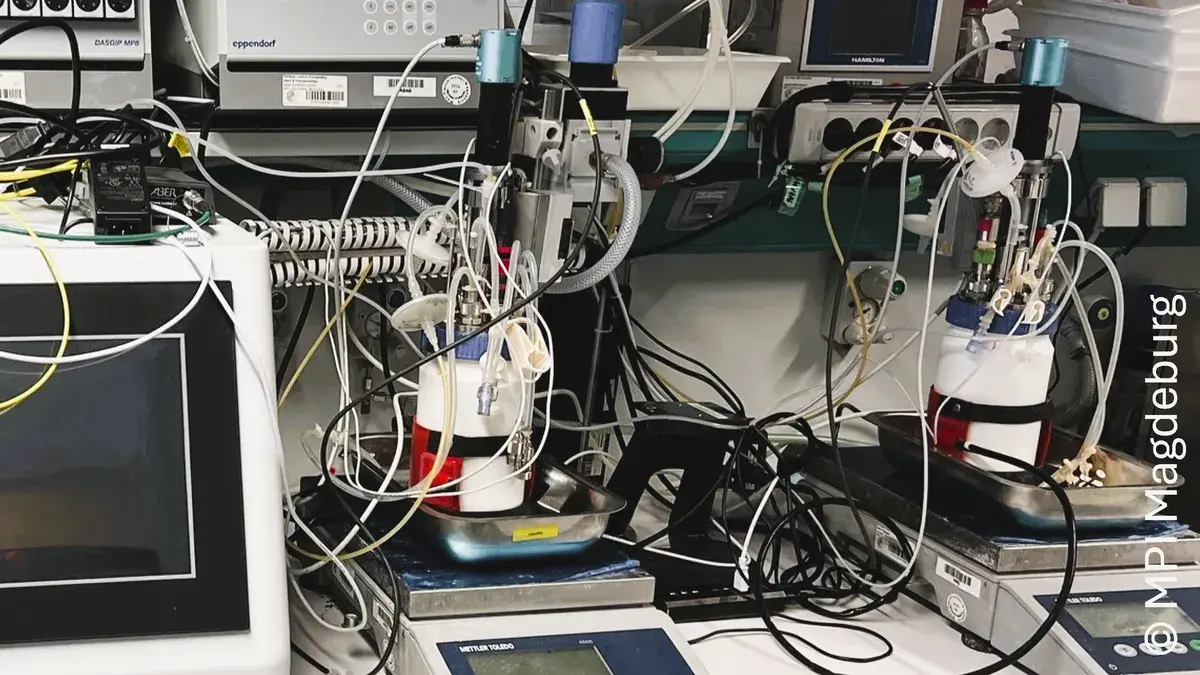
Cultures run with pDS inserts - in our own lab and with partners.
Request your introductory set
One introductory set per customer
- Launch price - sent with your offer
- Order by 31 December 2026
- Delivery within 8 weeks
Your contact
Rather talk first?
30 minutes with our team - for your Process Development or MSAT team.
Pick a time →Questions about the set
Which Ambr® 250 vessels does the set fit?
Both the Ambr® 250 modular and the Ambr® 250 HT vessels. You keep your standard vessel and simply place the insert inside - ports, probes and sparger stay exactly where they are.
What do short, medium and long stand for?
Three steps of mixing time between the standard Ambr® 250 (about 5 s) and large production reactors: at 350 rpm and 0.15 vvm about 29, 42 and 76 s until 95 % of the liquid is mixed (without gas 26, 39 and 51 s). Published values for 2,000 L single-use tanks lie between 30 and 65 s. The set does not copy one specific tank - it makes scale a factor in your DoE, next to temperature, pH and feed.
Do the inserts add shear?
Only a little. In the CFD, the shear with insert stays close to the empty Ambr® 250 and in the same range as a 200 L single-use tank. Gas bubbles bursting at the surface remain the main source of hydrodynamic stress, as in any sparged Ambr® culture.
At which stirrer speed?
At the stirrer speeds you already use in the Ambr® 250. Mixing gets slower at lower speed and with gassing, as in any bioreactor. Running unusual conditions? Let's talk before you order.
Does anything stick to the insert?
No - we have seen no build-up in E. coli, CHO or stem cell cultures. Filamentous fungi have not been tested yet; if that is your system, we would like to test it together with you.
How is the insert sterilised - is it reusable?
Inserts are made of nylon and single use. You autoclave them and fit them into the pre-sterilised Ambr® 250 vessel under the laminar flow hood. They are made by our ISO 13485-certified manufacturing partner; the certificate comes with every delivery.
I need more than one set - is that possible?
The launch offer covers one introductory set per customer. For replicates or a full 24-vessel campaign, ask us for a quote for additional sets.
Does the set replace runs at production scale?
It brings scale into your Ambr® screening. You see early which parameters react to scale and can adjust them while changes are still cheap, so your large-scale runs start from a scale-aware process and confirm instead of surprise.
