

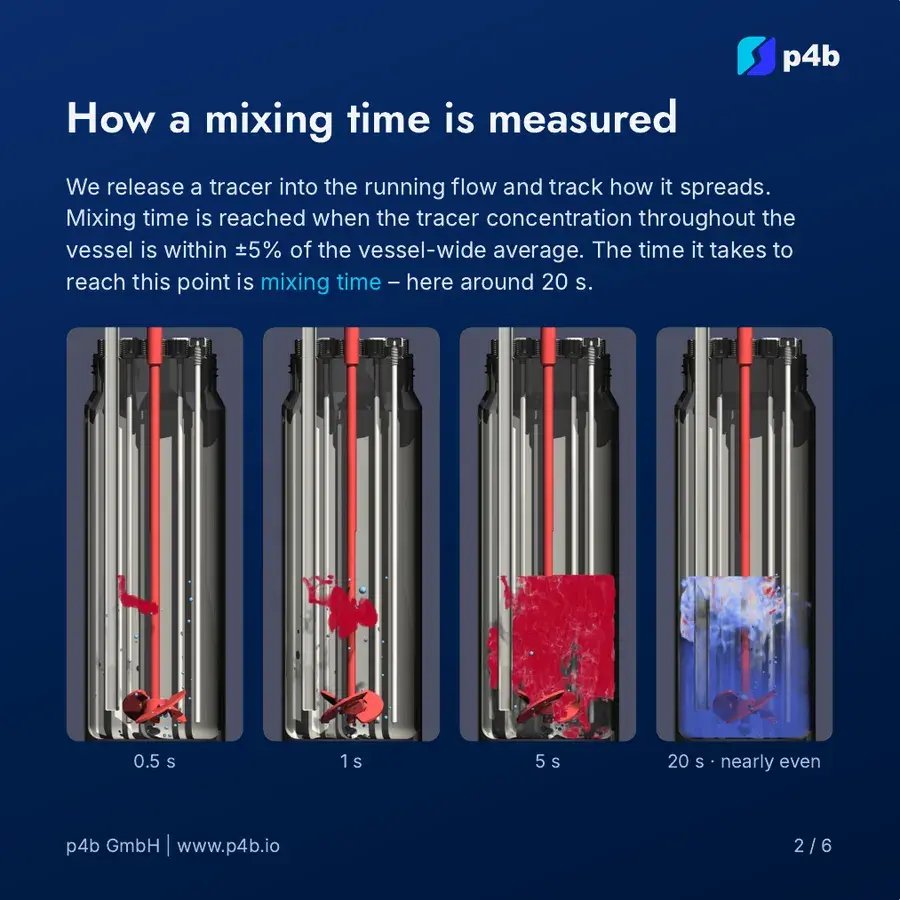
Same reactor, same speed, eleven mixing times
In a CFD study of an Eppendorf DASGIP vessel, we released eleven tracers into the same running flow and measured mixing times anywhere between 20.3 and 23.5 seconds. This is why one mixing time per reactor is not enough to compare two reactors.
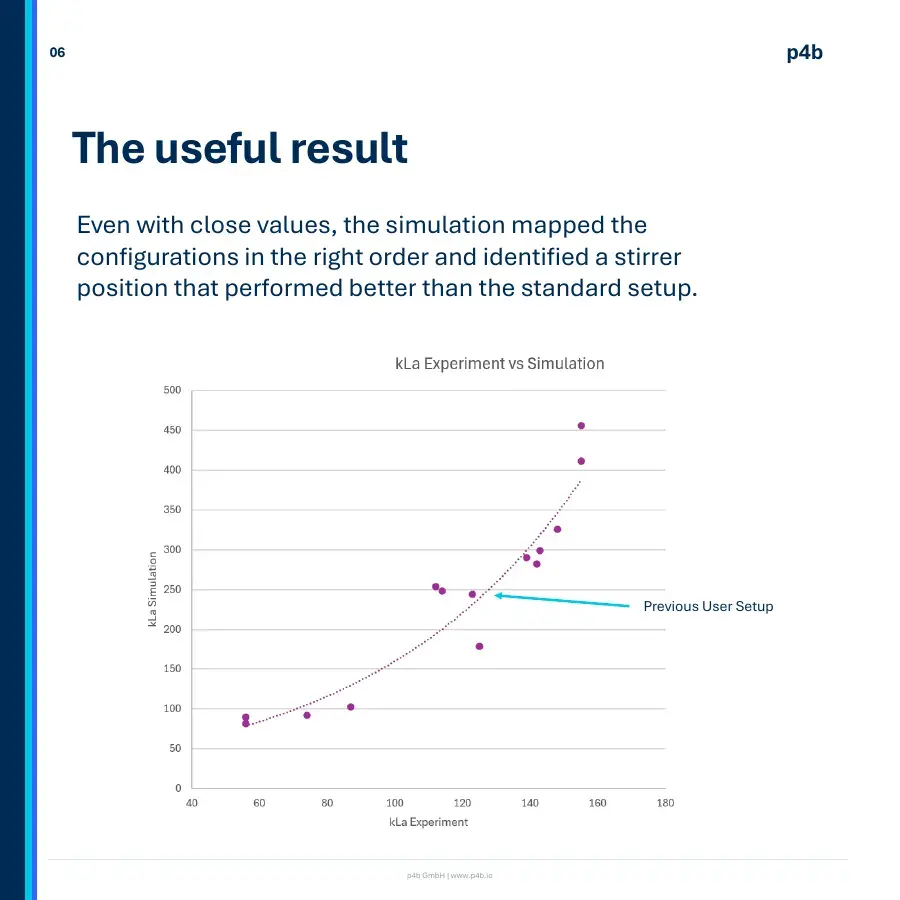
Validation first: can CFD rank stirrer positions by kLa?
In a demanding 2 L kLa comparison at 1.5 vvm and 1400 rpm, we changed only the stirrer position and compared CFD against experimentally measured kLa. Even though the values were close, the simulation ranked the configurations in the right order and found a stirrer position that performed better than the standard setup.
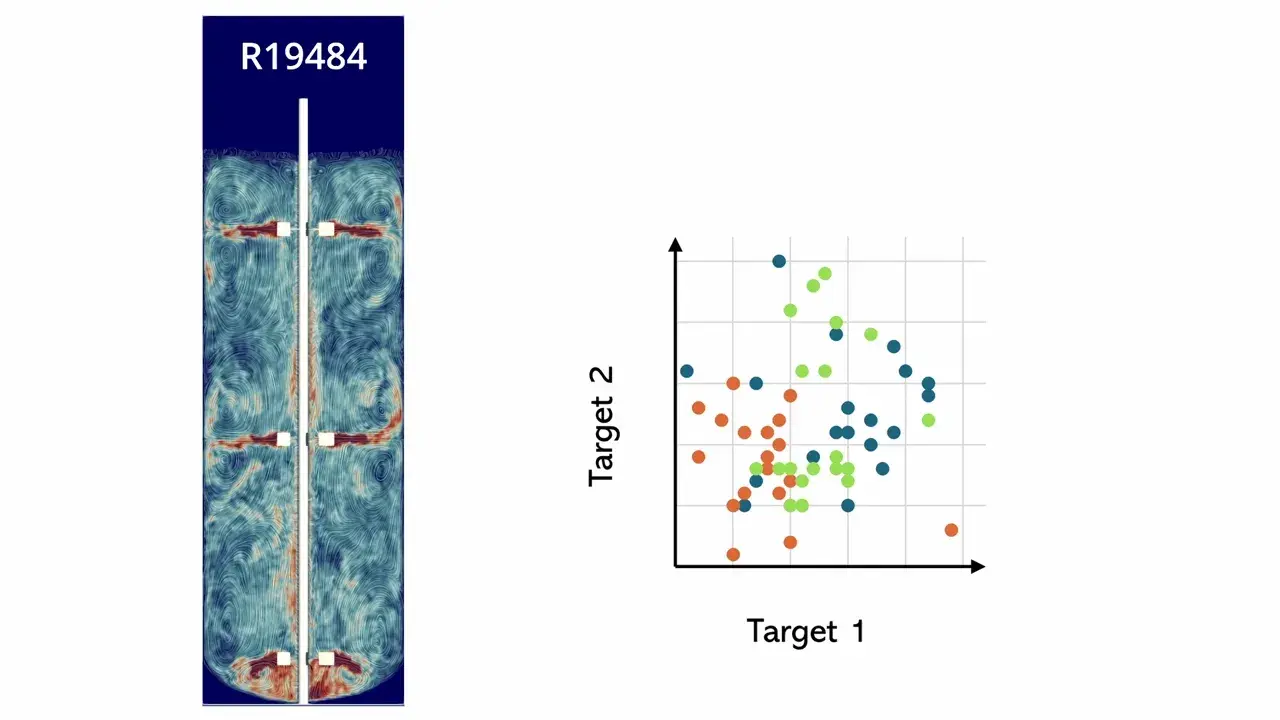
Introducing DREAM-bio: exploring whole bioreactor design spaces
DREAM-bio is p4b's digital bioreactor design and optimization service. Together with you we define the parameters to vary, then the simulations are generated and run semi-automatically and you get structured, comparable results across the whole design space.
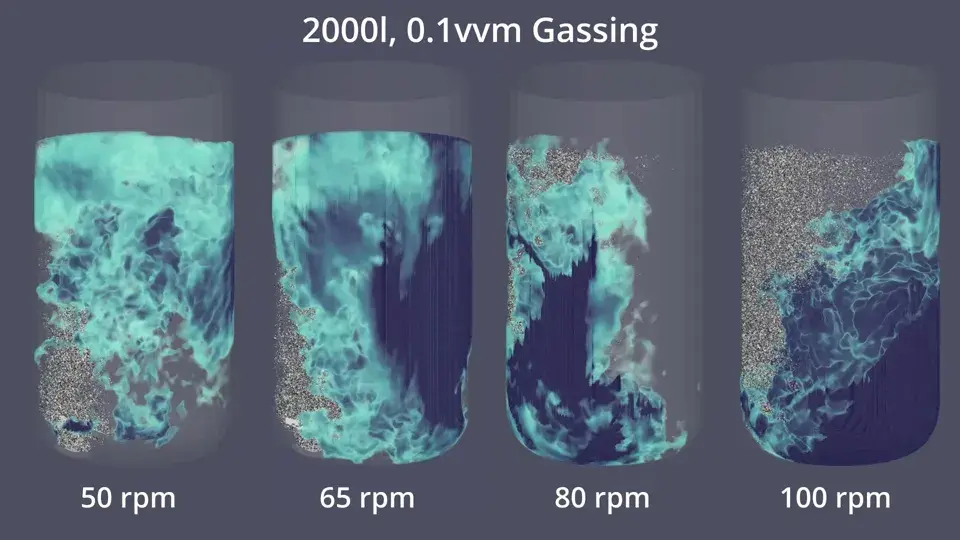
We expected 100 rpm to mix fastest. It didn't.
A gas-liquid CFD study of a 2000 L single-use bioreactor similar to a Cytiva XCellerex setup showed the fastest mixing at ~80 rpm and the slowest at 100 rpm. In this design, the impeller's main job is to control how far the gas plume spreads.
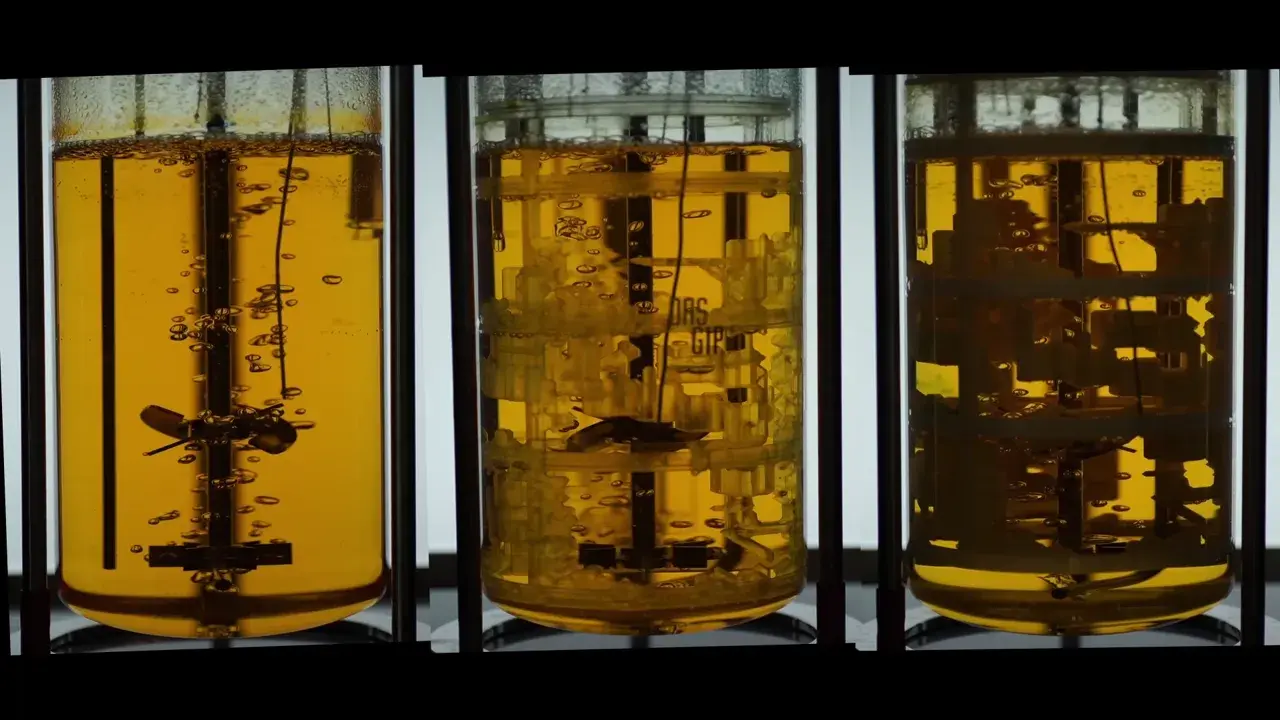
Scaling down the physics, not just the volume
At the University of Stuttgart, a 3 L reactor with a p4b pDS insert was tested in a pH-shift mixing experiment followed by a CHO process. With the insert, mixing slowed from a few seconds to about 30 seconds, matching what is expected in a 2000 L XCellerex.
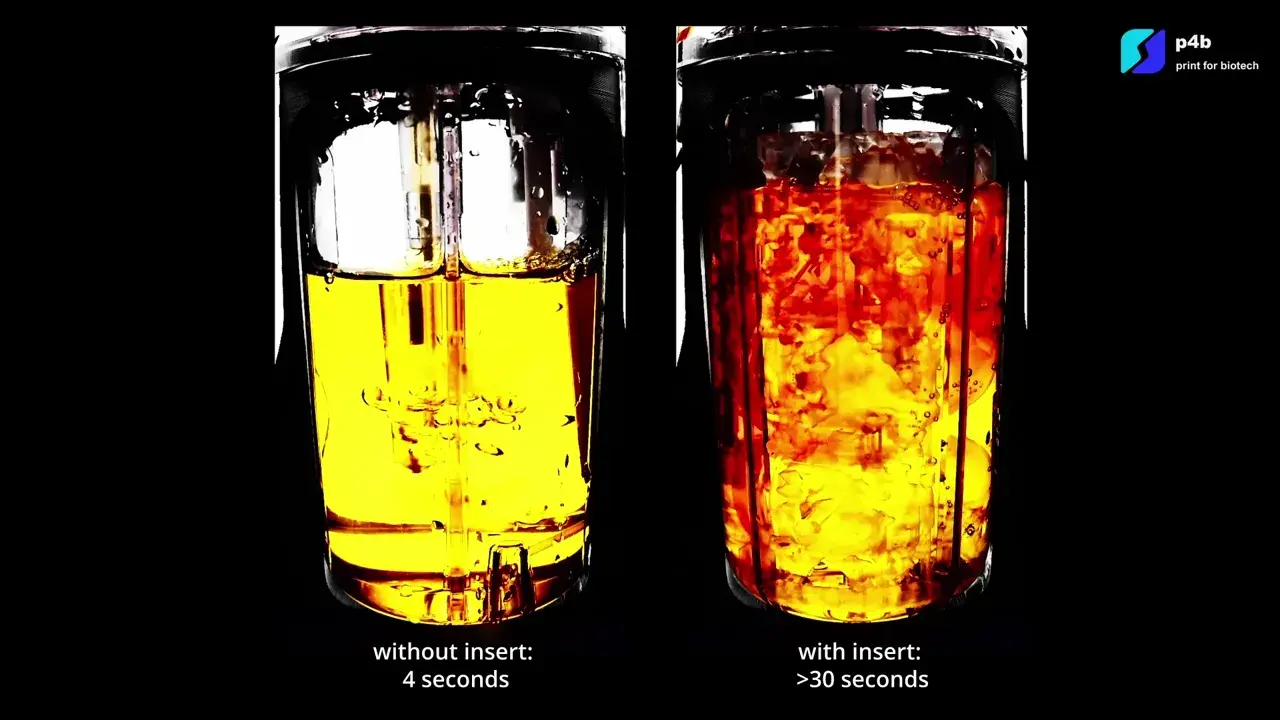
When 4 seconds become more than 30: off-the-shelf pDS inserts for the Ambr250
In one of our Ambr250 experiments, the vessel mixed in about 4 seconds without an insert and in more than 30 seconds with one of our off-the-shelf pDS inserts, approximating the mixing behavior of a 2000 L production bioreactor. Standard pDS inserts for the Ambr250 are now available off the shelf.
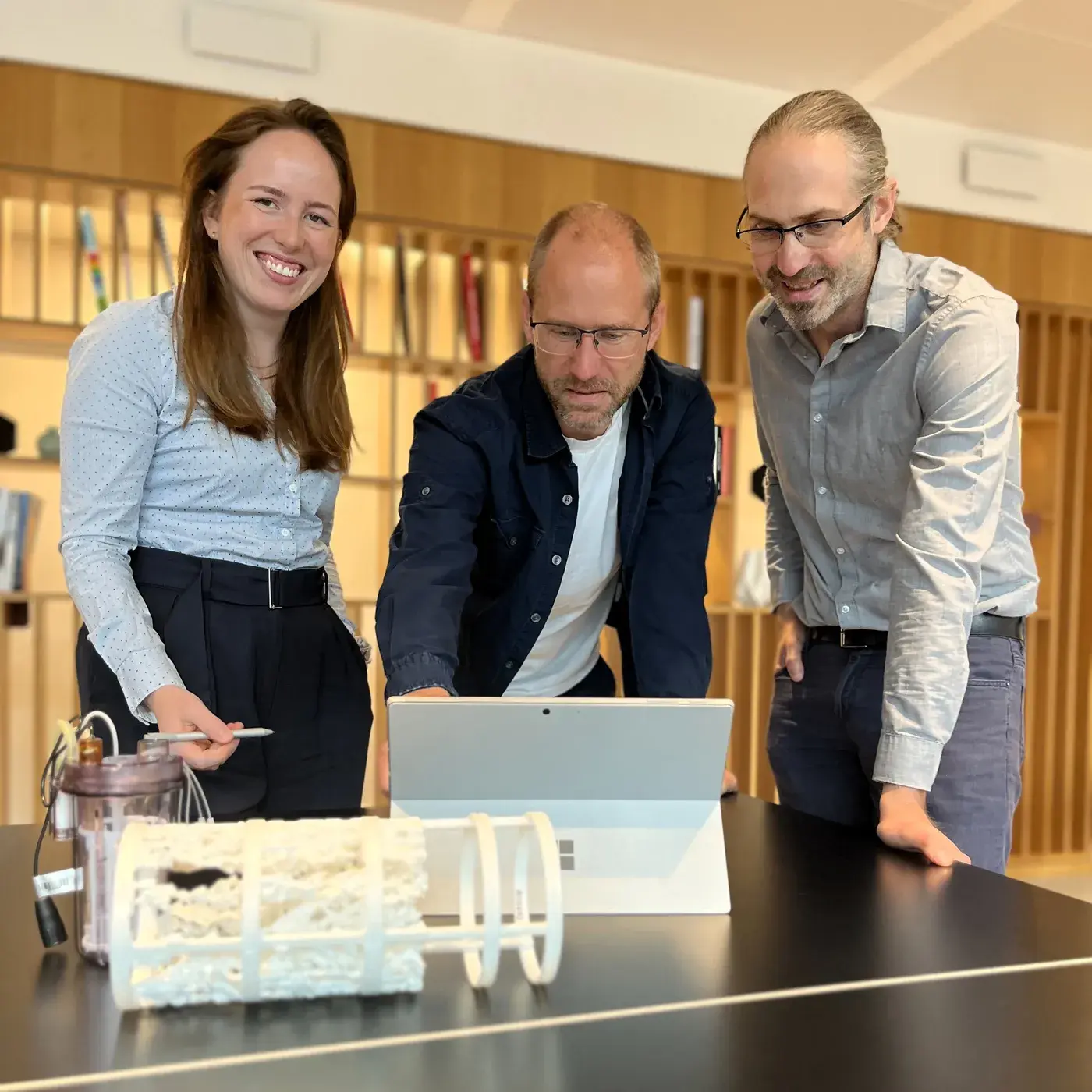
p4b at the BioProScale Symposium
Manfred Satzer and Lena Achleitner represented p4b at the BioProScale Symposium with an industry talk and a technical presentation. The conference had a strong scientific focus and plenty of good discussions.
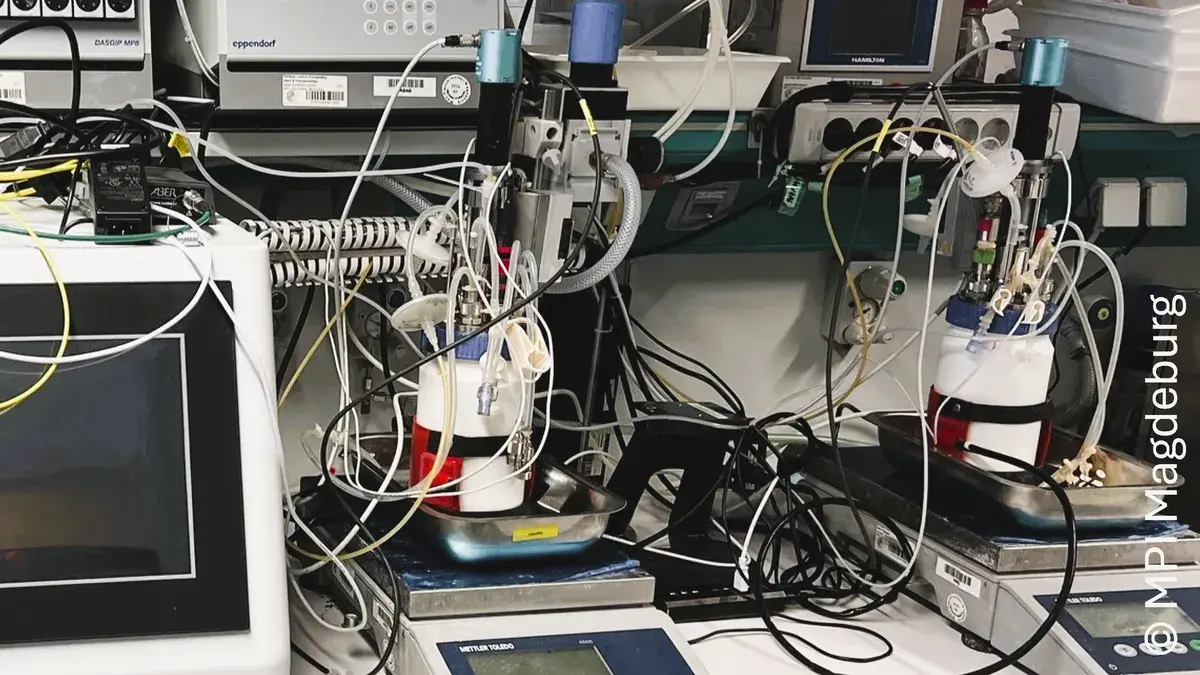
pDS reactors featured in a peer-reviewed article on Zika vaccine production
Our technology is featured in a peer-reviewed article by Sven Göbel and Yvonne Genzel's group at the Max Planck Institute (MPI). The 3D-printed down-scaled reactors made it possible to study, at bench scale, how viral sensitizers affect Zika vaccine production.
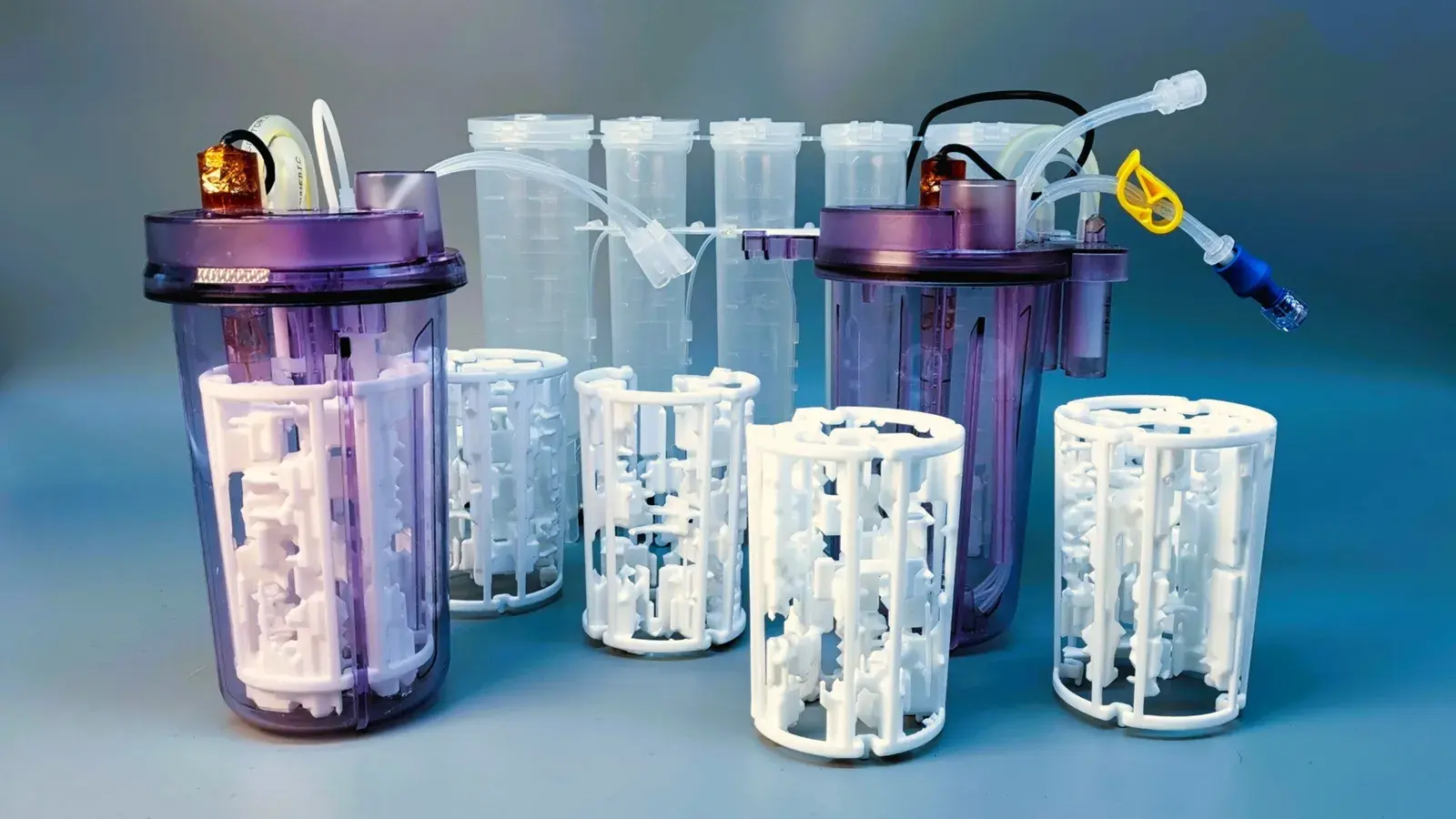
Large-scale conditions in a 1 L lab bioreactor
How a reactor designed by generative AI recreates the gradients of a 10,000 L scale in a 1 L vessel - and what they do to lactate and mAb titer in a CHO process. 4 pages, free.
Download the white paperLet's find out how your process reacts to scale
Tell us your system and target scale - we come back with a proposal for your insert set.
